Wednesday, 22 May 2013

The Plough, Bruntingthorpe, Leicestershire

The first time I popped in for a pint at The Plough in Bruntingthorpe, the place was so busy that taking photos was simply out of the question. This was a Sunday afternoon, a quiet time for many rural pubs.

It wasn't so long ago that the ritual of the pre-Sunday Lunch pint (often followed by the Sunday afternoon session) was almost universally supported, albeit mostly by men of course! But as we all know, the steady weekly traditions of pub-going have been seriously eroded in more recent times, so much so that many rural pubs are now barely ticking over on what was once one of the most sociable drinking days of the week.

So despite the slight inconvenience to my photographic interests, it's great to see a pub like The Plough as busy as this, particularly on a Sunday afternoon in the depth of winter time. But then take a look at the picture below and it's easy to see why the Plough's regulars wouldn't want to be anywhere else on a cold Sunday afternoon.


The Games Room at the Plough features Pool, Darts, and a well used and well maintained Skittles Table which sees service in the Dunton Bassett Skittles League and Dunton Basset Ladies Skittles League.

The impressive array of trophies in the bar of the pub include the three turned Mahogany 'cheeses' shown below for 'Player of the Season', 'Most Improved Player', and a 'Wooden Spoon' for an individual team player. It's not uncommon to find that additional trophies like these have been presented, particularly where pub games play is still popular and well supported at a pub. Lilacs of Isham had a similar trophy for example.

Friday, 17 May 2013

Snookerette - The Gedney Hill & District League


The external signage on the Black Bear in Wisbech advertises the pub game staples of Pool and Darts, no surprises there, but notice also that something called Snookerette is on offer at the pub. Now that's a game that not many will have heard of, although locally it's quite common, played as it is in a league of up to nine venues in the Gedney Hill & District League. So what might Snookerette be?

As you'll see from the image below, which was taken in the single large bar of the Black Bear, Snookerette is in fact the same (or very similar) to the much more commonly found, and almost universally named game of Bar Billiards. So why the curiously different name in this small part of Lincolnshire?


The cue game that we now know as Bar Billiards was effectively an import from continental Europe in the early part of the 20th century, where the game was known in the french speaking regions as Billard Russe, or Russian Billiards. The London firm of William Jelkes was the preferred manufacturer of the initial crop of tables in this country, and since a more palatable, less 'Soviet' name for the game was needed, Bar Billiards was chosen. More crucially, the name was also registered for use by Jelkes alone. The game proved to be popular, and inevitably a number of other manufacturers began to produce their own tables, often subtly different in design or dimensions, and all by necessity bearing a different trade name. The company of Alfred Sam's & Sons of Hertfordshire produced a four pin table (most are three pin models), and it's this model which is now found throughout the Gedney Hill & District league. Sam's appear to have chosen the name Snookerette for their tables.

Time has moved on since the early days of the game, and the term Bar Billiards is now almost universally used. But for some reason, the name Snookerette has persisted in the Gedney Hill area (and possibly elsewhere), such that you will be politely corrected by the locals if you make the mistake of referring to the game as Bar Billiards!

Match nights in the Gedney Hill & District League are usually on Thursdays, and there are Summer and Winter leagues, the latter slightly better supported. Needless to say, the tables are available for play outside of league match nights.


All the tables in the local Snookerette league carry the logo of the now defunct National Bar Billiard Association. The All England Bar Billiard Association now regulate the game, though the Gedney Hill & District Summer and Winter leagues are not affiliated to this body.


The Butchers Arms is located in one of the more attractive Fenland villages of Parsons Drove. The bar is a traditional drinking and gaming space with ample room for both Pool and Snookerette tables. The pub also acts as the unofficial licensed clubhouse of the adjacent Parsons Drove Bowls Club. The many trophies on display in the bar include the magnificent Shield shown below, which is still in use, with some of the older badges being replaced with new winners names when necessary.


Sunday, 12 May 2013

A Compendium of Pub Games Images - Pt 16


The Chestnut is a friendly and vibrant local, tucked away in a leafy residential area of Worcester. It's an interesting pub, run by an enthusiastic (and slightly eccentric) landlord. A recent addition to the bar is a full size Pine Pulpit, and afternoons can be spent browsing the extensive vinyl collection, with a record deck available to play whatever takes your fancy. This huge slate Shove Ha'penny was rescued from another pub and the landlord would love to see it get more use (though you may have to take your own half pennies). Alternatively, there's a Devil Amongst The Tailors for skittles fans.


There's a sign in the bar of the Rose & Crown in Oundle promising 'Darts and Dominoes Every Wednesday Night'. Sadly the rattle of Dominoes is no longer a weekly feature, but the Darts Board is still in situ and available to play.


Cribbage Boards, old and some not so old. The Pleasantime 'Once Around' Two Lane Cribbage Board on the left is American and from around the 1950's. It comes complete with a lovely set of wooden pegs, and a folded sheet giving the Basic Rules of Cribbage. The Crown and Anchor board has the look and simple charm of a homemade affair. The holes are huge for a crib board, and the pub name has been simply added using a letter punch of the type commonly used to mark woodworking tools.


Another well maintained, clean and tidy, yet cosy and full of character back-street village local. The Railway Inn at Ketton, Rutland, bucks the trend for upmarket, food driven, and largely characterless pubs which are becoming all too common in my experience, particularly in rural areas. I've lost count of the number of times a historic pub exterior merely dresses up a bland, stripped out interior. All blond wood laminate flooring and late 20th century brown leather sofas, more Swedish furniture store than traditional British pub in character. Thankfully, there are still pubs like the Railway, which along with the village shop is the true hub of the community. It's quite small within, which presumably accounts for being a drinkers pub rather than one noted for food. Despite its diminutive size, league Pool, Darts, Cribbage and Dominoes are all played at the Railway. Quite an achievement for a pub of any size these days.


Silver Medals like the one shown below were once quite a common reward for success in league and cup games play. I've seen examples for everything from Dominoes to Quoits and Skittles, sometimes hallmarked, occasionally even featuring a gold element. All I know about this one is that it was presented in 1949 to an F. Souster for some measure of success in Darts. It's a shame there's not a little more information about the league/competition, and what exactly the achievement would have been that the medal was presented for.

Tuesday, 7 May 2013

Three Tuns, Wisbech, Cambridgeshire


Old established family brewers like Elgoods seem to value their pub estates that much more than non-brewing pub companies. Pubcos (and sadly this includes some of the very large brewers) are so divorced from the business of brewing and selling ale, that their estates are merely there for short-term cash flow, or medium-term property investment. A brewery which owns its own pubs has a vested interest in their success since they act as a shop window for the brewers craft. Time and again, if it's the best of unspoilt traditional British pubs you're looking for (and a genuine, well-run Free House is not available), those owned by the old established family brewers are the ones that seem to deliver the goods more often than not.

A good many beer enthusiasts don't seem to value these more traditional boozers very highly though. The choice of beers not nearly exciting enough, the conversation not nearly 'beery' enough. Novelty, extreme hop rates, and unusual flavours are what beer enthusiasts favour, all of which can be more commonly found in a shiny new beer bar, no matter how dull and impersonal the interior. Even a Wetherspoon has more value to the beer enthusiast than a pub which has developed and grown within the local community for generations. The beer range is better you see, which for some seems to be all that matters.

Pubs like the Three Tuns are not for beer geeks though, they service the needs of people who perhaps have a better understanding of what makes the great British pub so unique and envied throughout the world. People, conversation, and the sense of belonging to a community that a true local engenders. Entertainment, games, and perhaps even drinking good beer, but without feeling the need to spend all night talking about it!


The Pool Table has now gone from the Three Tuns, but Darts, Shove Ha'penny, and a very good Dice Set are available for play in the comfortable front bar.

The bar itself benefits from a fairly typical set of Elgoods liveried stained glass windows, the small panes and sparse decoration giving the bar a slightly subdued lighting level which really suits the traditional decor, and very well suits an afternoon pint.

The dice is a good quality Abbot Ale set, containing a Shut The Box, Poker Dice, and Crown & Anchor amongst others. The Shove Ha'penny could do with a good polish and a bit more use.


Thursday, 2 May 2013

Brunswick Arms, St Johns, Worcester

The first sight to greet you at the front entrance of the Brunswick Arms is this unusual timber construction, a coin tossing game called  Grenuoille, more commonly found in French or Belgian bars. Lovingly homemade by the licensee, it's just one of the dozens of traditional pub and bar games which form licensee Chris Hankins extensive collection.

The Brunswick is a kind of one-stop-shop for traditional pub games. The collection includes just about every game you can think of, including the once popular local game of Indoor Quoits or Dobbers, as well as more common examples such as Shove Ha'penny and Shut The Box. The thing about the Brunswick is that these games are not just for show. Chris is keen for all the games in his collection to be played and enjoyed by his customers, and like myself, sees games as an important part of the social pub-going experience.

Total games immersion includes the twice monthly meeting of the local Subbuteo Club at the pub.


From right:  A rare and unusual Shove Snooker board. The Canadian game of Crokinole. A Carrom table, Asian in origin. A nice Mahogany Shove Ha'penny (see below).


The Quoits Board is a Jaques model, including the floppy rubber quoits, white on one side, which are traditional to the game. The other ring-flinging game at the Brunswick is the Rings Board shown below. This is the standard 13 hook design as played in Ireland. The game was once quite widely played in England, particularly in the north, but is now only rarely seen outside of the Isle of Wight where the game is still played in the Ventnor & District Rings League.


The Shove Ha'penny is a good quality board with brass lifters. Note that the bar comes equipped with several Shut The Box games, and a Put & Take is also available, though presumably not for the purposes of gambling! Even a humble formica-topped table has been converted to a Shove Ha'penny at the Brunswick.


The 'Shoving' format of pub games spawned many different games during its heyday, most of which have now effectively disappeared, not only from pubs but more generally. I've already featured a slate Shuv Billiards game on here, and I've also seen a Cricket version as well as many variations on the theme of propelling coins up a smooth surface.

This Shove Snooker game would presumably have involved 'flicking' coins rather than shoving, but like many of these unusual and largely obsolete variants, the rules are very hard to come by, so there will always be a certain amount of guess work involved when it comes to how it was played. One thing's for sure, I can't see a full set of snooker balls being represented on a board of this size.

The Dutch game of Sjoelbak is located in the garden of the pub, and gets well used on warmer days apparently. The idea is to slide wooden 'pucks' up the board, scoring by getting them to slide through the four numbered slots at the top of the table.

Saturday, 27 April 2013

A Compendium of Skittles Images

black hORSE SKITTLE SALOON
This Image has kindly been made available by Leo Reynolds under a Creative Commons Licence.
The grandly titled Skittle Saloon at the Black Horse in Norwich is now long gone, as indeed is the pub which closed for good over 40 years ago, the building now an opticians. What kind of skittles would have been played at the pub I wonder! Devoting a whole room to the game would suggest something a little more substantial than a Devil Amongst the Tailors, so perhaps it housed an alley of some kind. A Table Skittles tradition has been noted for Norfolk, played on a table similar in size to the Kent game of Daddlums which is somewhat smaller than a Northamptonshire Skittles Table. But would a game of this size warrant a whole Saloon? There are currently no known examples of the Norfolk game in existence.

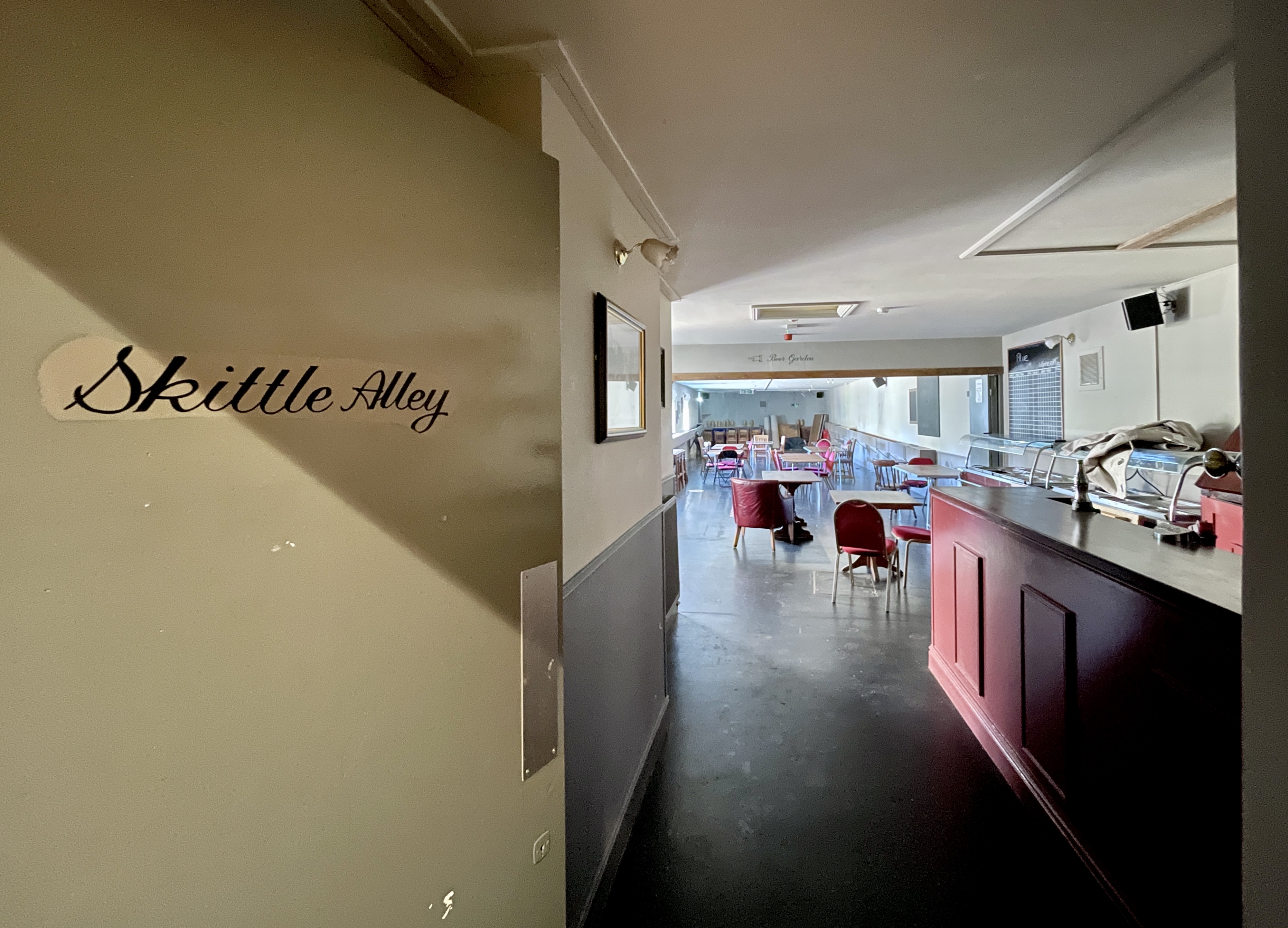
This Skittle Alley is at the Bell Inn, St Johns, Worcester (right). Despite being very busy, the assembled competitors and spectators were happy for me to take a few photographs during a hotly contested Sunday afternoon cup match.

This is a popular and very well used skittle alley, located in an extension at the rear of this unusually laid-out 17th Century locals pub. Well worth a visit when in Worcester.

The pins are of the 'Bristol' type (see below), the white painted ends and stripe on the leading pin is purely to help give players something to aim for. The dark wood of the balls suggests that they are made from Lignum Vitae, preferred by many skittlers over more modern alternatives as they have the correct weight for their size and are very durable. The disadvantage of Lignum balls is that they can reduce the life of both the pins and alley surface.

I've included a picture of the all important 'Sticker-Uppers'. Usually a pair of local lads or family members, employed for the day to put the pins back up and return the balls during a game. You won't find too many Sticker-Uppers in East Midlands skittling, that job is done on a rota basis by the players, but this system is the norm throughout the West Country and West Midlands.


The Skittle Pins shown here are the classic 'Bristol' shape, 10 inches tall and around 4.5 inches across. Bristol pins come in different sizes, and there use is not confined to the Bristol area. These pins originally saw service in a Worcester pub, but they are not the very best quality, which may explain why they've been retired to my ownership whilst still in reasonably good condition. The better quality pins are made from a solid piece of well seasoned Beech or Sycamore, often treated with Linseed oil. The pins shown here are fabricated from several pieces of Beech wood bonded together before being turned and varnished. Whilst they are perfectly adequate for general play, I'm not sure they'd be durable enough for a well used alley like the one at the Bell Inn, particularly if the harder Lignum Vitae or composite balls are preferred. Rubber balls are available which are more suitable for this quality of skittle.


The Dukes Arms in Burton Latimer, Northamptonshire is a sparse, drinkers pub, just the kind of establishment you're likely to find a well used skittles table in the county of Northamptonshire. A brass plate on the front leg indicates that this table has been refurbished by John Tonks in 1998. Note the large sheet of ply wood at the rear of the table, used to protect the glazed doors on the right during play.

Monday, 22 April 2013

The Cock, Broom, Bedfordshire


Don't be put off by the Greene King signage on The Cock, it's well worth visiting for a pint (there's usually a guest beer or two), and you'll be made very welcome if my own experience is typical. The pub is another treasure on CAMRA's list of Heritage Pubs. Much altered and extended over the years, but done in such a sensitive way that The Cock can be held up as a great example of how pubs can develop to keep pace with changing circumstances without being spoilt in the process.

The interior is a mellow blend of old polished wood and red floor tiles. There are several distinct areas for drinking as well as a separate dining room, all linked by a narrow wood panelled corridor, the floor tiles worn to a shallow groove through many years of traffic to and from the cellar door. Beer is served straight from the cask and delivered to the top of the cellar steps on a tray. There's no bar counter to get in the way at The Cock.

The pub currently opens all day every day, which is great news if, like myself, you've been disappointed far too often by the ever more limited opening hours of rural and village pubs. Whilst it's reasonable to expect pubs to limit their lunchtime or even evening opening during the week, I'm finding it  increasingly difficult to find a rural pub open on a Saturday afternoon, often one of the main times I'm looking for a pint when out and about. The difficulty with The Cock is that having found the pub open, you may not want to leave in a hurry.


The Games Room is located directly to the left on entering the pub, and houses a Darts Board and a well polished Skittles Table. Pins and Cheeses are the pale yellow plastic variety favoured in the Bedfordshire game. The table has a couple of faded labels on the legs, probably marking this out as a W T Blacks model. Now no longer in league use, a collection of trophies in the Snug attest to the skittles action which would have once taken place at the pub.

Given the small size of the games room at the Cock, the Skittles throw is positioned on the diagonal to achieve the correct distance. Consequently the Darts and Skittles Oche's share space on the tiled floor. As far as play is concerned it's one or the other, unless some kind of strict rota is in place.


Trophies in the snug include two from the Lord Roberts Skittles League. There is a Lord Roberts pub in nearby Sandy. This league now appears to have been consolidated to form the Beds & Roberts Skittles League.